


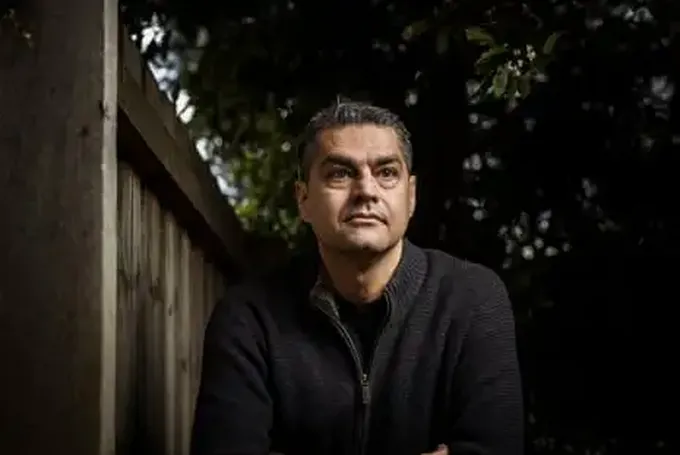
Saeid Zand could hear the panic in his sister’s voice, though she tried to hide it.
More than 12,000km away in Zand’s birth country of Iran, she delivered disturbing news over a WhatsApp call.
Their mother was on the radar of Iran’s feared Islamic Revolutionary Guard Corps (IRGC), which had accused her of illegally posting “criminal” content online, she said.
In a phone call from a private number in late March, a male voice had warned their mother that her son should stop his anti-regime activism in Australia. Then, he uttered the name of Zand’s nine-year-old son and the Melbourne suburb they previously called home.
“I was shocked,” Zand says, recalling the conversation with his sister in May.
“I was feeling disconnected to the world and the surroundings for a couple of minutes.”
His mind started racing. Should he tell his wife? Was his mother safe? What could happen to his son?
Like many Iranian Australian activists, Zand lives with the lingering feeling that he is being watched in Australia. He fears that personal details provided to the Iranian embassy in Canberra, as part of his eldest son’s passport application in 2017, were passed to the IRGC – a branch of Iran’s armed forces separate to the military – and used to harass his mother in an attempt to silence him.
More than a year after the Albanese government expelled Tehran’s ambassador to Canberra over the IRGC’s ordering of firebombing attacks on home soil, the country’s diaspora says Iran’s long arm into Australia continues to threaten, intimidate and surveil community members who speak out against the regime.
Zand, a Melbourne-based architect who left Iran in 2013, had participated in local protests as part of the 2022 “Women, life, freedom” movement. But it was the brutality of the regime’s crackdown on the January protests – with estimates of 30,000 Iranians killed – that propelled him into public activism this year. He began organising weekly anti-regime protests in Melbourne.
Mehdi Nabiyan, a wildlife researcher who migrated to Australia in 2023, began attending protests in Melbourne after discovering that one of his former students had been killed in the January uprising, which was initially sparked by concerns about the country’s economic crisis. On Instagram, he posted videos and photos from the Melbourne protests as the crowd numbers calling for regime change in their home country swelled.
Nabiyan assumed he was free from the reach of the regime and could protest freely in Australia.
But in June, he received emails from the Iran-based Saman Bank, viewed by Guardian Australia, stating that funds had been withdrawn from his accounts due to judicial orders issued by a branch of the public and revolutionary prosecutor’s office.
double quotation markI understand, I am not safe even being 15,000km away from IranMehdi Nabiyan
He has been unable to view the allegations against him as his foreign IP address is blocked from accessing the Iranian website. In March, Iran’s prosecutor general’s office warned that Iranians living overseas could have property confiscated or face other legal consequences if they expressed support for the United States or Israel, state media reported.
Nabiyan, who is the sole breadwinner for his parents in Iran, says a government-issued subsidy to help with the cost of living was stopped when the judicial orders were issued.
“I understand, I am not safe even being 15,000km away from Iran,” he says, through a translation that has been verified by Guardian Australia.
Last August, the federal government expelled the Iranian ambassador after the Australian Security Intelligence Organisation (Asio) accused the IRGC of directing at least two attacks against Australia’s Jewish community. It found that the Iranian embassy and its diplomats were not involved in the IRGC-directed attacks.
The government subsequently announced it would list the IRGC as a state sponsor of terrorism.
While some Iranian Australians have called for Tehran’s embassy in Canberra to be closed since 2022 due to foreign interference concerns, the expulsion of the ambassador has sparked renewed calls within the diaspora, with a petition referred to the home affairs minister this month.
Reza Pahlavi, the exiled son of Iran’s former pro-western monarch who is expected to travel to Australia at an unconfirmed date, , has signalled he will ramp up pressure on the federal government to shut down the embassy, which still operates consular services. In a meeting with Coalition MPs last week, Pahlavi also raised concerns about intimidation directed at diaspora communities, including Iranian-Australians.
A 2022 parliamentary inquiry received submissions alleging that Iranian embassy officials, including the consular sector in one case, were among those monitoring, intimidating and threatening diaspora members.
Despite the expulsion of Tehran’s top diplomat in Australia, there is persistent fear within the Iranian community that proxy networks, hardline supporters of the Iranian government and individuals linked to or paid by the regime are involved in the surveillance of critics.
In his annual threat assessment in June, Mike Burgess, the Asio director general, singled out foreign regimes harassing citizens and permanent residents as one of the major threats to Australia’s “degrading security environment”. Last week, Burgess told the radio presenter Neil Mitchell’s podcast that prominent Jewish Australians could be targeted for assassination by Iran.
Burgess’s warning came as the Senate’s foreign affairs, defence and trade references committee began investigating the issue of transnational repression – when foreign governments reach beyond their borders to suppress or silence dissenting individuals – and foreign interference, including the impact on diaspora communities.
Alongside instances of transnational repression linked to the Iranian regime, community members also point to intimidation tactics where it is difficult to determine who is behind them.
Weeks after Iranian Australians began holding protests in support of the country’s January uprising, the prominent activist Ali Beikzadeh – who had spoken at the demonstrations – was walking to his car outside his home in Sydney. As he neared the vehicle, he noticed its rear window was smashed.
Beikzadeh says no other vehicles in the street were damaged and nothing was taken from the vehicle.
“It’s very clear that it’s not a coincidence and someone came and targeted my car simply for the purpose of telling me that they know where I am,” he says.
While Beikzadeh was not physically harmed, the incident exemplifies the risks diaspora members take when they advocate for change in Iran.
In Melbourne, Zand stepped away from his advocacy work when he first received his sister’s phone call. But it was his mother’s words, reminding him of the thousands of young Iranians who lost their lives while protesting against the regime, that changed his perspective.
“She said … do whatever you can,” he says. “And then I keep going. That’s why I’m doing what I do now.”
An Australian government spokesperson said it would not tolerate attempts by foreign governments to “promote violence and discord” in the country.
“Despite our strong concerns with its actions, Iran remains a significant regional and international player that impacts on Australia’s interests,” a statement said.
The spokesperson said the Iranian embassy remained open so the government could pursue Australia’s national interests and for onshore consular services but was not an endorsement for the regime’s conduct.
The Iranian embassy did not respond to questions.
-
Additional reporting by Shadi Khan Saif